Venue: Council Chamber - Civic Centre, High Street, Uxbridge UB8 1UW. View directions
Contact: Lloyd White, Head of Democratic Services Email: democratic@hillingdon.gov.uk
| No. | Item |
|---|---|
|
Apologies for Absence Minutes: Apologies for absence had been received from the Deputy Mayor (Councillor Reeta Chamdal), Councillors Bennett, Roy Chamdal, Garg, Goddard, Judge, Lewis, Money, Nelson and Palmer. |
|
|
To receive the minutes of the meeting held on 22 January 2026 (attached). Minutes: RESOLVED: That the minutes of the meeting held on 22 January 2026 be agreed as a correct record. |
|
|
Declarations of Interest To note any declarations of interest in any matter before the Council Minutes: There were no declarations of interest in matters coming before this meeting. |
|
|
Mayor's Announcements Minutes: The Mayor welcomed the journalism students from Brunel University to the Council Chamber. Since the last Council meeting, he had attended the Community Awards ceremony at the Battle of Britain Bunker to celebrate the work of some of the volunteers in the Borough who had enhanced the lives of residents and improved the area.
The Mayor thanked those who had supported his Valentine’s Quiz. He advised that a Cheese and Wine event would be held at the Civic Centre on 11 March 2026 and a St George’s Day Quiz would take place at the Morello Lounge in Uxbridge on 23 April 2026.
As this was his last meeting before the election, the Mayor took the opportunity to thank Members for electing him as Mayor and wished them all the best for the future. |
|
|
Report of the Head of Democratic Services Minutes: i) Changes to Committee Memberships
Councillor Edwards moved, and Councillor Bianco seconded, the urgent item as set out on the Order of Business and it was:
RESOLVED: That the following changes to membership of Council Committees be approved: · Councillor R.Mills to replace former Councillor Burrows on the Registration and Appeals Committee. · Councillor Dhot to replace former Councillor Burrows on the Hillingdon Planning Committee.
ii) Members’ Allowances 2026/27
Councillor Edwards moved, and Councillor Bianco seconded, the motion as set out on the Order of Business and it was:
RESOLVED: That the current Members’ Allowances Scheme be revoked as of 31 March 2026 and the new Scheme for 2026/27, as shown in Minute Annex A, be approved for implementation from 1 April 2026. |
|
|
Confirmation of Article 4 Direction To consider the results of the statutory consultation and confirm the Article 4 Direction (attached) Minutes: Councillor Tuckwell moved, and Councillor Edwards seconded, the motion as set out on the Order of Business and it was:
RESOLVED: That the introduction of a boroughwide immediate Article 4 Direction under the Town and Country (General Permitted Development) (England) Order 2015 to remove the permitted development right for the change the use from a building and any land within its curtilage from a use falling within Class C3 (Dwellinghouse) of the Town and Country Planning (Use Classes) (Amendment) (England) Order to a use falling within Class C4 (House in Multiple Occupation) of that Order being development comprised within class L(b) of Part 3 of Schedule 2 to the Town and Country Planning (General Permitted Development) (England) Order 2015 (as amended), be confirmed. |
|
|
Safer Hillingdon Partnership Community Safety Strategy To consider a recommendation from Cabinet (attached) Additional documents: Minutes: Councillor Bridges moved, and Councillor Edwards seconded, the motion as set out on the Order of Business and it was:
RESOLVED: That the Safer Hillingdon Community Safety Strategy 2026-2029 be adopted as a policy framework document. |
|
|
Six Month Performance Report 2025 / 2026 To consider the latest six-month Performance report (attached) Additional documents: Minutes: Councillor Edwards moved, and Councillor Bianco seconded, the motion as set out on the Order of Business and it was:
RESOLVED: That the Performance Report 2025/26 be noted. |
|
|
General Fund Revenue Budget, Housing Revenue Account and Capital Programme 2026 / 2027 To consider the recommendations of Cabinet which will be published, once agreed. The report to Cabinet is available at:
London Borough of Hillingdon - Agenda for CABINET on Thursday, 19th February, 2026, 7.00 pm
Section 106 of the Local Government Finance Act 1992 will apply to the recommendations of this item. Any Member who is more than two months in arrears with their Council Tax or has arrears of Council Tax must declare that fact and not vote on this item.
Budget Conflict Resolution Procedures – Council is asked to consider the Cabinet’s proposals. It may adopt the proposals, submit objections to Cabinet or invite the Cabinet to make amendments specified by Council. If Council votes to object to the Cabinet proposals or to invite Cabinet to make amendments, then the Conflict Resolution Procedure will come into operation.
The Council meeting will be adjourned while a special meeting of the Cabinet is held, after which the Council will resume and consider any revised proposals submitted by the Cabinet or the reasons why the Cabinet disagrees with Council’s objections or proposed amendments. The budget would then be open for debate and amendment until a final decision is made.
Members are asked to note that, in accordance with the Local Authorities (Standing Orders) (England) (Amendment) Regulations 2014, recorded votes will be taken at the annual budget setting meeting on any motion, amendment to motion or substantive motion regarding the General Fund Revenue Budget, Housing Revenue Account and Capital Programme. Additional documents:
Minutes: Councillor R Mills moved, and Councillor Gohil seconded, the suspension of Council procedure rule 14.4 to allow unlimited speaking time for the mover and seconder of the motion.
RESOLVED: That the mover and seconder of the budget motion be allowed unlimited speaking time on this item.
Councillor Lavery moved, and Councillor Edwards seconded, the twenty-one budget recommendations as set out on the Order of Business.
Councillor Punja moved, and Councillor Mathers seconded, the following objection amendment:
“In accordance with the Council Constitution, the Labour Group formally moves an amendment to the Cabinet’s budget recommendations in the form of an Objection.
“This objection relates specifically, though not exclusively, to the significant challenge and delivery risk associated with the proposed savings programme, which leaves the 2026/27 budget being set in a context of “continued material risk”. As stated in the Chief Financial Officer’s Statutory Opinion under Section 25 of the Local Government Act 2003, the robustness of the estimates must be considered alongside the adequacy of reserves and the authority’s capacity to deliver its financial plans.
“We are concerned that the Cabinet’s budget estimates, and the conclusions regarding the adequacy of reserves, rely on a series of critical assumptions and proposed mitigating actions. However, the current governance, oversight and control environment has not yet been sufficiently embedded or consistently demonstrated to provide confidence that these assumptions are reliable or that the 2026/27 budget can be delivered within a defined and realistic timescale.
“In recent years, deliverability against savings targets has not been achieved as planned. It is therefore not sufficient to rely on high-level modelling without a full and transparent explanation of how the underlying assumptions have been determined. We require clear evidence of the rationale, methodology and sensitivity analysis used to derive the modelling figures, and assurance that these assumptions are credible, evidence-based and resilient to risk.
“Furthermore, we consider that the proposed budget lacks: · Robust and detailed contingency planning proportionate to the scale of the financial risk; · Clear trigger points for corrective action should savings not be delivered to profile; · More detailed and frequent review mechanisms to monitor delivery, governance compliance and risk mitigation.
“Given the material risks identified, and the absence of sufficient assurance regarding the reliability of assumptions and deliverability of the savings programme, we believe it is not prudent to approve this element of the budget in its current form.
“Therefore, in accordance with the Conflict Resolution Procedure set out in the Constitution, we move that Council resolves to object to these elements, as stated above, of the proposed budget and instructs the Cabinet to reconsider and strengthen the relevant plans, assumptions and delivery framework before the budget is finalised.”
Those speaking in support of the Objection thanked officers for their work on the budget and noted that Section 24 was not a footnote, but a law, and noted that the Opposition had not been required to put forward an alternative budget. The Objection had been raised around concerns that the budget had been based on assumptions that had not been fully evidenced.
Two months after the Administration had agreed last year’s budget, it had fallen apart and controls were not working properly and had still not been embedded. There was no solid evidence to demonstrate that savings would be delivered within the required timescales and no trigger points had been included for corrective action to be taken. There was no transparency, with oversight and Oracle both failing, and Members had not been given any clarity over savings or growth so there were concerns that the growth identified was actually just rebasing.
In 2022, the Council had had £74m in reserves. This was now projected to be -£31m. The Conservative Administration had overseen the erosion of the Council’s financial resilience with year after year of undeliverable savings. Financial experiments had been pursued that had not delivered and there was now a continued reliance on assumptions. Members were being asked to agree a budget that was based on continued financial risk and where assumptions were being made without scrutiny. The Objection was about making sure that the same mistakes were not repeated.
Officers were not being blamed for the Council’s financial system, the Conservative Administration was being blamed as it had acted too slowly and would not confront its own record. It was taking the local authority down a reckless financial path by taking £150m in Exceptional Financial Support (EFS) just to keep the lights on. Only 35 out of 300 councils had received EFS and some were investing in their communities such as Ealing, who would be investing £30m in community services in 2026/27.
It was recognised that EFS came with strings attached including the requirement that the Council would have to increase Council Tax by 4.99% every year for the next three years. The Administration had not acknowledged the challenges that it had faced and this had not been helped by ineffective scrutiny (the last call-in had been more than twenty years ago).
Those speaking against the Objection suggested that it had insulted the professionalism of the Council’s officers when they did not have the opportunity to respond and did not provide residents with possible alternative proposals. The Opposition would rather make those without gardens pay for those who did have gardens.
The 2026/27 budget would be achievable and clearly set out precise timescales with controls in place. The Labour Group had been trying to subvert the professional judgement of the S151 Officer as this did not support their narrative and they were unable to produce a credible alternative vision.
The Opposition had been suggesting that the Council was about to go bankrupt for a long time and they couldn’t have been more wrong. EFS had been treated as a slur by Labour Members despite Hillingdon being one of nine London local authorities this year to have been awarded EFS, including Waltham Forest (which had been a Labour run council for many years) and Lambeth (which had already benefitted from additional support beyond that received by many London authorities).
The amendment, in the form of an Objection, was put to a recorded vote:
Those voting for: Councillors Burles, Garelick, Gill, Islam, Kaur, Lakhmana, Mand, Mathers, Nelson-West, Punja, Sansarpuri, Singh and Sweeting.
Those voting against: The Mayor (Councillor Corthorne), Councillors Ahmad-Wallana, Banerjee, Bhatt, Bianco, Bridges, Choubedar, Davies, Denys, Dhot, Edwards, Gohil, Haggar, Higgins, Lavery, Makwana, Martin, D Mills, R Mills, O’Brien, Riley, Smallwood, Sullivan and Tuckwell.
Those abstaining: Councillors Abby, Basit, Curling, Farley and Gardner.
The amendment was lost.
Those speaking in support of the original motion noted that the Administration had developed core policies relating to low fees and charges, low Council Tax and digital enablement. The aim being to try to leave as much money as possible in residents’ pockets.
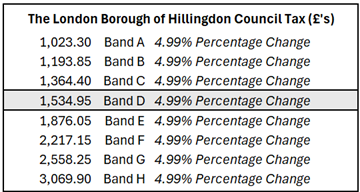
At £1,534.95 for a Band D property, Hillingdon had the second lowest Council Tax rate for an outer London borough, which was 17% less than average. Hillingdon had been underfunded for some time despite the local population growing by 11% since the 2021 census.
Even though inflation had been running at between 8% and 12% in Adult Social Care, the Council’s spend per head on Children’s and Adults’ Services was also below average when compared to its near neighbour comparator group. 38% of the Council's total budget had been spent on Adults’ services, 22% on Children’s services and £34m had been spent on temporary accommodation in 2025/26. The Council was not being fully funded for these services.
The high needs spending block had been a challenge with an in-year deficit of £9.7m. However, this was expected to reduce to £8.3m in 2026/27 and it had been agreed that the statutory override would be in place until 2028. Thanks to the Cabinet Member for Children, Families and Education and Council officers, Hillingdon had received a letter from the Government praising the authority for how well it had been doing in reducing its Dedicated Schools Grant (DSG) deficit.
Hillingdon had the third lowest spend for the provision of Children’s Services and had fewer Looked After Children than the national picture. 2025/26 had focussed on living and learning in local communities and fourteen new foster carers had been brought online (with another fourteen being processed). Reoffending in Hillingdon was lower than its statistical neighbours and demand management in SEND had been stabilising.
The Opposition had never explained what it would not do to ensure that funding was available for the things that it would do. Their election material in the Colham and Cowley Ward had stated that they were fighting the green waste collection charges but this had not been borne out in the Chamber. The Administration challenged the Opposition to identify the proposals that it would put forward and how it would do things better, rather than just objecting to the Administration’s efforts to improve things for Hillingdon’s residents.
Although the Labour Government had made some progress, it was noted that the Fair Funding Review would result in ‘fairer’ funding but not ‘fair’ funding and, despite what Danny Beales MP had said, the Council had not received £120m. The funding would need to cover inflation and, despite it being recognised that Hillingdon was currently underfunded, this would not be properly addressed for three years. £28.7m of the anticipated settlement would be expected to come from a 4.99% increase in Hillingdon’s Council Tax rate every year for the next three years.
The funding system was fundamentally flawed and no allowance had been made for Hillingdon being a port authority with Heathrow Airport within its boundaries. The Council received 30% of the business rates that were levied in the Borough and, although there had been a proposal to increase Heathrow’s business rates by 353%, this was likely to be appealed. Although this Borough collected the fifth highest amount of Business Rates in the country, there were 95 other local authorities that retained more of the Business Rates that they collected than Hillingdon. One favoured council had collected £102m less than Hillingdon in Business Rates in the previous year, yet its settlement included £55m more in Business Rates.
All savings proposals included within the budget had been owned by the Corporate Directors and their departments and covered the year 2026/27. The budget had included increases to fees and charges but Hillingdon would continue to be a low charge borough. During the consultation period, the Council had received 277 responses which compared favourably to the previous year when 144 responses had been received.
The Council had an in-principle agreement to receive £62m in EFS from the Government in 2026/27. This meant that the Council had been able to reset reserves to £40m and include a contingency of £10m. It was noted that EFS allowed councils to treat some revenue expenditure as capital spend and that Hillingdon was one of 35 local authorities that had been granted EFS (London Councils had predicted that this number would rise over the coming years).
Work had already been undertaken on the development of a new leisure centre in West Drayton (which, it was hoped, would open in time for the Easter holidays) and the new library in Uxbridge (the old site had been sold to Buckinghamshire New University) and hundreds of homes would be developed or purchased through a £194.5m programme of investment over the next five years. The Avondale Drive and Hayes Town Centre developments continued as well as those in Haydon Drive and on the Yiewsley Recreation Ground site.
The pressure on housing and homelessness could not be ignored so action was being taken to prevent homelessness before it occurred. The Labour Group had never acknowledged the financial challenges faced by local authorities and the way that the Administration had delivered year after year. It was easy to oppose and hard to govern but this Administration would not neglect the basics. Town Centre investment would continue so that residents and businesses could continue to thrive in a Borough that they could rely on.
In November, the Labour Group had suggested that Hillingdon give the Government the power to make decisions on behalf of the Council which, it was suggested, was putting residents third. It was noted that the Council had been presented with a responsible and prudent budget which reflected a clearer and more stable position for the year ahead. Despite having access to officer expertise, the Labour Group had not come up with any alternative budget proposals and had also been unable to find enough candidates to stand in the upcoming election.
Whilst it was acknowledged that Ealing would be investing £30m in community services in 2026/27, Hillingdon would be investing £42.6m and another £136m in housing.
It was anticipated that there would be real term cuts forecast for years two and three and the Government was unable to resist the pressure to spend on social care (the criminal justice system and the armed forces were also desperate for funding). It was likely that the future would bring more regulation, unsustainable student debt and higher taxation, resulting in a growing demand for council services.
Councils were being pushed down the same path whereby a large proportion of the budget was being spent on a small percentage of residents. In Hillingdon, around 33% of the budget was spent on about 5% of the population rather than on universal services. Even though residents were going to be paying more for their Council Tax, most people would be getting fewer services. However, the Administration would continue to fight to retain weekly waste collection despite the expectation that an increasing proportion of the cost of services be paid by local government as it became a delivery arm of central Government. The decline in spending power needed to be stopped.
The growth in grant funding had not been sufficient enough to allow for service growth so costs and blame was being shunted around. EFS and Fair Funding were steps in the right direction but structural issues, such as the Business Rates system being in disarray, needed to be addressed.
The Fair Funding Review was supposed to have determined how the total amount of funding available to local government should be shared out. It was recognised that it would take time to reduce the amount of funding that some previously overfunded councils received but those that had been underfunded needed to receive the increased amount immediately to ease the pressure that they faced. Two councils had been in a position to freeze Council Tax for 2026/27, seemingly in a move to win the election in May 2026, but they already had Council Tax that was £1k lower than Hillingdon which was a low tax authority.
The Government’s £2.6m Recovery Fund (RF), the Enhanced Recovery Fund and the £5m Pride In Place grants had distorted the outcomes of the new funding formula. One of the London Labour councils would be receiving RF, Recovery Grant Funding, Recovery Grant Uplift Funding and Protection Floor Funding totalling £95.2m over the next three years in addition to their Fair Funding Formula allocation. Meanwhile, Hillingdon would receive £65m less than its Fair Funding Formula allocation during the same period. In 2028/29, once Hillingdon had received its full allocation, the Labour Council in question would still have a per capita spending power of at least one third higher than Hillingdon.
Although the proposals offered a significant improvement, the Council would continue to push for fairer funding and would ensure that the budget stayed within the financial envelope. Services would not be cut and the Council would continue to invest and innovate.
Those speaking against the original motion argued that the budget was just rebasing and was resetting services rather than improving them. Previous budgets had been unrealistic and residents were now facing the consequences. Members were being told that controls were being tightened but they should not have been weakened in the first place – underfunding had not allowed Hillingdon’s systems to weaken, mismanagement had.
The Council had had three Chief Finance Officers in three years with their opinions on the authority’s financial position getting increasingly worse over time. Comments had included reference to financial weakness around structural funding pressures, evidence of bias, use of reserves relied upon for recurring gaps and the need for external support. Despite corrective measures, the Chief Finance Officer had said that the budget was worse than the previous year, given the information available.
The forecasts were unreliable and there had been a reported pattern of failure which remained unresolved and was based around a flawed implementation. The Council had never achieved the savings targets that it had set itself. The auditors (Ernst & Young) had not received assurance that the forecasts were accurate and Members queried how a credible budget could be built on figures that could not be trusted. This failing Administration had relied on a Labour Government bailout and had produced a failing budget.
On 9 February 2026, the Labour Government had agreed to cover 90% of the high needs deficit. The Administration had done nothing about this deficit except let it grow and grow when councils such as Ealing had managed to keep theirs down to £5m. Hillingdon had been saved by the Labour Government but would still need to own the remaining 10% and manage the growing deficit.
Although the Administration bragged about being a low cost council, MyLondon had just rated Hillingdon as one of the worst places to live. 30% of Hillingdon’s homes would fail the decent homes standard and cremation costs had increased from £681 to over £1,000. The Community Safety Team had been reduced and reports of fly tipping and potholes were increasing. The Administration had made choices which had left residents feeling poorer, less safe and less supported.
The Administration’s decisions had included: the closure of Uxbridge Library and moving it to the Civic Centre; a proposal to close three early years centres; hiring consultants for the Beck Theatre, then not providing a long term lease and continuing to pay a subsidy to the contractor; closing the Rural Activities Garden Centre; the Uxbridge Post Office closing with no alternative location identified; and introducing a green waste charge and thereby breaking a manifesto promise. The Conservatives had abandoned their own voters.
It was suggested that the Administration was unaware of the lobbying that had been undertaken by the Labour Group to get the DSG written off or EFS secured. Bringing all services into the Civic Centre was not always going to be the most appropriate solution.
Concern was expressed that the Council had leased out the Cowley Meeting Hall to a former Conservative Councillor and was now taking legal action relating to this issue. It was queried whether there were any other controversial issues being hidden away.
The original motion was put to a recorded vote:
Those voting for: The Mayor (Councillor Corthorne), Councillors Abby, Ahmad-Wallana, Banerjee, Bhatt, Bianco, Bridges, Choubedar, Davies, Denys, Dhot, Edwards, Gohil, Haggar, Higgins, Lavery, Makwana, Martin, D Mills, R Mills, O’Brien, Riley, Smallwood, Sullivan and Tuckwell.
Those voting against: Councillors Burles, Farley, Gardner, Garelick, Gill, Islam, Kaur, Lakhmana, Mand, Mathers, Nelson-West, Punja, Sansarpuri, Singh and Sweeting.
Those abstaining: Councillors Basit and Curling.
The original motion was carried and it was:
RESOLVED: That:
a) £786,851,076 being the aggregate of the amounts that the Council estimates for the items set out in Section 31A (2) (a) to (f) of the Act. (Gross Expenditure including the amount required for additions to working balances)
b) (£622,055,728) being the aggregate of the amounts that the Council estimates for the items set out in Section 31A (3) (a) to (d) of the Act. (Gross Income including reserves to be used to meet Gross Expenditure)
c) £164,775,348 being the amount by which the aggregate at 4 (a) above exceeds the aggregate at 4 (b) above. This is calculated by the Council in accordance with Section 31A (4) of the Act, as its Council Tax requirement for the year. (Item R under Section 31B of the Act)
d) £1,534.95 being the amount at 4 (c) above divided by Item T (2 above). This is, calculated by the Council in accordance with Section 31B of the Act, as the basic amount of its Council Tax for the year. (Council Tax at Band D for the Council)
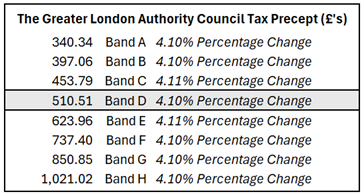
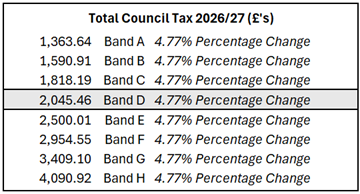
being the amounts given by multiplying the amount at 4 (d) above by the number which, in the proportion set out in Section 5 (1) of the Act, is applicable to dwellings listed in a particular valuation band divided by the number which in that proportion is applicable to dwellings listed in valuation B and D. This is calculated by the Council in accordance with Section 36 (1) of the Act, as the amounts to be taken into account for the year in respect of categories of dwellings listed in different valuation bands;
|
|
 PDF 397 KB